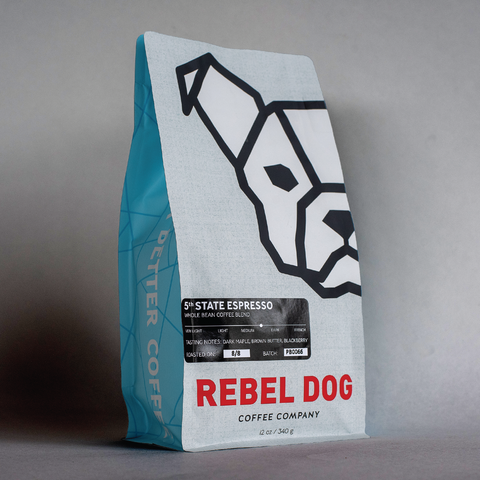
5th State Espresso
Our flagship espresso blend is built to please the taste preference of all old school and new school espresso drinkers. This blend pairs wonderfully with milk and creates a beautiful crema, which is ideal for latte art, but it's also made to be absolutely delicious no matter which way you brew it!
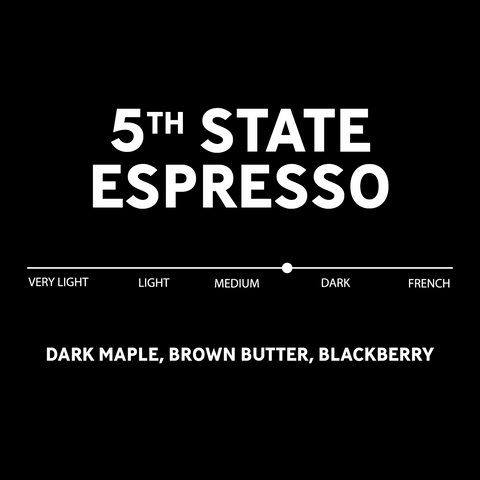
We are currently tasting dark maple, brown butter, and blackberry in 5th State.
BUY ONLINE, PICKUP IN STORE!
What's in 5th State?
Varieties: Bourbon, Catuaí, Caturra
Growing Altitude: 1,300 - 1,900 masl
Processing Method: Fully Washed
This coffee comes from young farmers throughout the Peruvian Andes who belong to Cooperativa Agraria de Jóvenes Pangoa - The Agrarian Cooperative Land of Young People and Women.
Founded in 2015, the cooperative is made up of 109 coffee farmer members, sons and daughters of CAC Pangoa members at its foundation, coming from native communities and migrants from throughout the Andes. Jóvenes Pangoa is dedicated to the production and export of coffee and cacao, with a focus on innovation, sustainability, and inclusion.
Leaders of the cooperative are involved in the entire production process, from harvesting and wet processing to export logistics, ensuring a supply chain without intermediaries. The result is strengthened financial benefits and resiliency, and improved market access, for its members.
With an emphasis also placed on continuous quality improvement and rigorous quality control processes to ensure excellence in every cup, members of the cooperative are producing high-scoring coffees with exceptional sweet, dense beans with notes of fruits, chocolate, and nuts.
You can learn more at https://tierrajovenesymujeres.com/home, and by checking out this presentation.
Varieties: Castillo, Caturra, Colombia
Growing Altitude: 1,500 - 2,000 masl
Processing Method: Washed
Dulima was created in 2009 to honor the coffee profile of the central and south Huila region. Around its mountains, outstanding coffees are grown, which are carefully selected through a rigorous sensory analysis to guarantee the profile consistency and quality. Dulima was inspired by indigenous groups from the southern region of Colombia, representing the ancient culture of its dedicated farmers.
This blend from smallholder farmers throughout the mountainous central and south Huila beautifully represents coffee from this region with lots of red fruit and citrus notes balanced by a rich chocolatey smoothness and body.
Varieties: Bourbon
Growing Altitude: 1,500 - 2,000 masl
Processing Method: Natural
This natural process coffee is produced by smallholders in Rwanda who deliver to RWACOF (Sucafina in Rwanda) washing stations.
Smallholders delivering to RWACOF washing stations receive fair prices and agronomic support. They cultivate an average of 200 to 300 trees at altitudes of 1,500 to 2,000 meters above sea level. These high altitudes, combined with fertile soil and good agricultural practices, produce high-quality cherry that is carefully processed at RWACOF stations to preserve and develop these delicious flavors.
In concert with their sustainability partner, Kahawatu Foundation, RWACOF invests heavily in yield improvements, farmer training, quality improvement projects, environmental sustainability and other ways to increase farmer livelihoods.
RWACOF’s Farmer Development Program in partnership with the London School of Economics (LSE) supports farmers with training in Good Agricultural Practices and access to loans, farm inputs and farm services. A new soil health initiative uses soil analysis data that RWACOF collected to identify farms where soil is too acidic. Lime, along with education about application, is distributed to these farmers to help improve soil quality. Additionally, seedling nurseries provide up to 4 million seedlings per year to help farmers renovate their rootstock.
RWACOF also has many projects that are designed to support farmers’ overall livelihoods. They focus on gender equality and support several women’s cooperatives by helping them access land, seedlings and reach a market for their coffees. They offer trainings on financial literacy and alternative income-generating activities.
On the environmental side, RWACOF has worked with partners to help install solar panels at 2 washing stations that are off the electrical grid. RWACOF’s dry mill already have a 50 kilowatt-per-hour solar panel set up on their roof. They’ve also mapped carbon emissions in their coffee supply chain and are starting projects to half their emissions per kg of coffee. Two ways they’re accomplishing this is by facilitating a transition from inorganic to organic fertilizer and further improve waste (water and pulp) management at the wet mills. They’re also working with Trade in Space to map deforestation in the supply chain so that they can begin to work with farmers to reduce deforestation and improve forested areas in the supply chain.
Above all, RWACOF's exceptional attention to detail during post-harvest activities ensures the best quality coffee possible. From the moment cherry enters the washing station until it is milled and bagged for export, RWACOF keeps stringent quality controls in place. They know, as we do, that high-quality coffee is crucial for delivering benefit all along the supply chain.
Varieties: Catuai, IHCAFE 90, Lempira, Pacas
Growing Altitude: 1,000 - 1,650 masl
Processing Method: Washed
This delightful washed lot is produced by smallholder producers working with Exportadora San Vicente in the Santa Barbara Mountains, a mountainous massif of more than 121.3 square kilometers of surface and a maximum height of 2,750 meters above sea level. The mountain is predominantly a reserve of virgin forest declared a national park in 1987. Farms are located on the mountain at an altitude range of 1,000 to 1,650 meters above sea level.
These farms belong to a group of independent producers who are clients of Exportadora San Vicente. Their relationships with Exportadora San Vicente span more than 25 years. About 70% are small producers with production areas of 4.4 hectares on average.
Our producing partners are dedicated to upholding their coffee-producing traditions, instilled by their parents and grandparents. Most producers are 3rd or even 4th generation coffee producers.
The majority of the farms are relatively young, with an average age of 5 to 10 years. This youth is due to the fact that enormous plant renovation had to occur in the wake of an intense attack of coffee leaf rust (CLR) in 2011 that killed most coffee trees in the region and in much of the rest of the country. The subsequent renovations were carried out with a focus on coffee varieties resistant to rust.
The resulting coffee in our blend is sweet with primarily nutty and citrusy notes, along with some chocolate and florals.