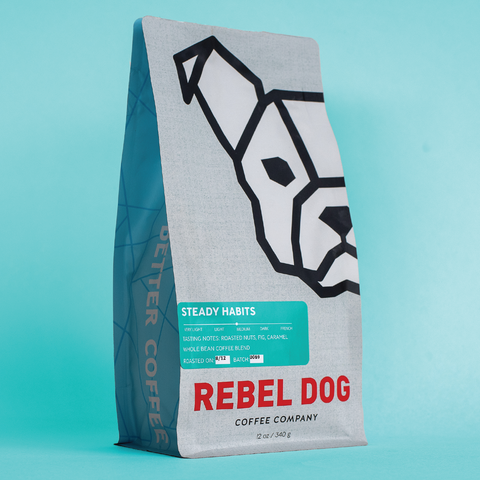
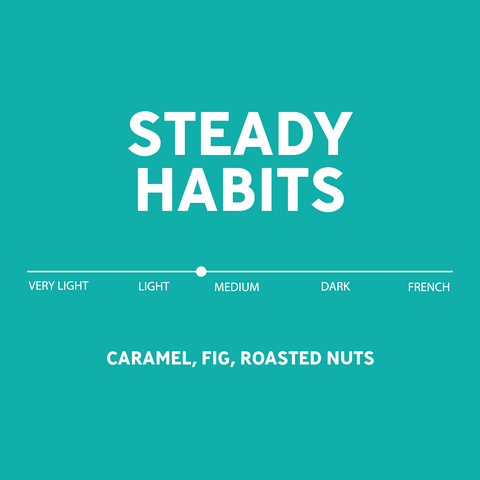
Steady Habits House Blend
Our signature house offering blends coffees from Colombia, Nicaragua, and Burundi in a medium-light roast for an easy-to-drink, everyday coffee. We chose the name Steady Habits, an unofficial moniker for our home state of Connecticut, to reflect this coffee’s reliability and approachability for all coffee drinkers.
We are currently tasting notes of caramel, fig, and roasted nuts in Steady Habits.
BUY ONLINE, PICKUP IN STORE!
What's in Steady Habits?
Varieties: Anacafe 14, Bourbon, Catuai, Pache
Altitude: 1,400 - 2,000 masl
Processing Method: Washed
This washed lot of coffee was processed at Covoya/OFI’s cherry mill in Ayarza, Santa Rosa. In Guatemala, coffee is traditionally processed individually by smallholder farmers, making it difficult to manage and guarantee quality from lot to lot, but the team in Ayarza works with numerous farmers in the region, paying a premium for ripe cherry and processing it centrally to maintain strict standards throughout. This particular coffee is exceptionally sweet and balanced, and is bursting with notes of dried blueberry, chocolate syrup, caramel, apple, and fig.
The region of Ayarza is a special one, landmarked by the drastic landscape and cold blue water from the Laguna de Ayarza and Laguna Azul. The lake was formed by two massive volcanos that collapsed and formed a large crater. Covoya Guatemala always knew the region had massive potential to produce specialty coffee, and several years ago rented a wet mill at 1,500 meters on a RFA certified farm. The quality coming from the washed coffee was much better than they expected, leading to development on several types of processing methods.
Several of our core coffees now come from the Ayarza Mill, due to their consistent high quality and exceptional taste, as well as for the opportunity to contribute to the educational, health care, and sustainability projects implemented by our importer Covoya (and their parent company OFI) around the mill.
In the Ayarza and Huehuetenango regions of Guatemala, coffee harvesting season coincides with the children's school vacation. For many families in the coffee regions, they are stuck with a dilemma: on one hand, the parents need the income from picking coffee, and on the other, there are limited options for childcare while they work. As the first to bring the Child Labor Monitoring & Remediation System (CLMRS) program to the coffee sector in Guatemala, OFI/Covoya created Coffee Kindergartens and Coffee Camps to support these working families. The communities that receive the Coffee Kindergartens are determined by risk assessments done in the field in partnership with their on-the-ground social workers. Coffee Kindergartens are set up in public schools where children learn, get a meal, and play with other children under the care of competent teachers for 35 school days during peak harvest.
In the community of Manzanillo, Ayarza, the closest local public clinic is an hour plus walk. The Blue Ayarza coffee that we source from Covoya is processed at this mill. To support the local community, Covoya opened a rural health clinic in 2021. The Clinic is open two days a week for walk-ins. The other three days, the nurse is in the field training the surrounding communities on preventive health measures, best practices, and doing home visits. Through field visits, over 2,000 children have been screened for malnutrition, given supplements, and seen at follow up visits. The clinic is provided free of charge and basic medicines are also provided free of charge. In the first two years, the clinic also performed over 700 primary consults in the clinic, and made over 7,000 total visits/trainings/campaigns for common illnesses in the surrounding communities.
Variety: Bourbon
Growing Altitude: 1,650 – 1,800 masl
Processing Method: Washed
Businde Washing Station, located in the northern province of Kayanza, collects cherry from around 650 local farmers living within about three miles of the station. Matsisi pays 20% above the local market rate for high-quality cherry deliveries, while Businde station's permanent staff receive nearly 60% more than typical casual labor rates. Once the cherries arrive at Businde, they undergo strict quality controls, including controlled fermentation processes and 20 days of drying on African raised beds, resulting in exceptional coffee.
Founded by Matsitsi Zuberi in 2015, Matsitsi Trading focuses on producing high-quality specialty coffee in Burundi. The company operates three washing stations, two in Kayanza province and one in Muyinga province. These stations invest in processing infrastructure and maintain traceability, while contributing to the local communities and sustainability, in the form of wastewater treatment and compost projects from unused coffee pulp.
This coffee brings its fair share of brown sugar and chocolate notes, as well as of orange zest and apple.
Varieties: Castillo, Caturra, Colombia
Growing Altitude: 1,500 - 2,000 masl
Processing Method: Washed
Dulima was created in 2009 to honor the coffee profile of the central and south Huila region. Around its mountains, outstanding coffees are grown, which are carefully selected through a rigorous sensory analysis to guarantee the profile consistency and quality. Dulima was inspired by indigenous groups from the southern region of Colombia, representing the ancient culture of its dedicated farmers.
This blend from smallholder farmers throughout the mountainous central and south Huila beautifully represents coffee from this region with lots of red fruit and citrus notes balanced by a rich chocolatey smoothness and body.