
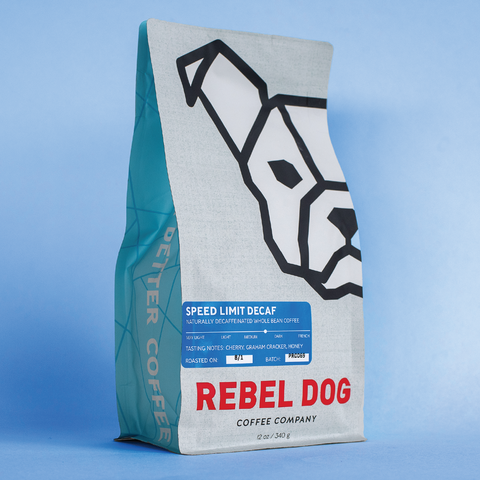

Speed Limit Decaf
Our current decaf offering is a single origin, naturally decaffeinated Colombian coffee that uses Ethyl Acetate (EA), a naturally occurring ester found in bananas and, for this purpose, as a by-product of fermenting sugar cane. This process is exceptional for maintaining the integrity and sweetness of the green coffee even as the caffeine is removed (until only a maximum of .001%-.003% remains).
We are currently tasting notes of cherry, graham cracker, and honey in Speed Limit.
BUY ONLINE, PICKUP IN STORE!
Learn More About Speed Limit Decaf
Varieties: Various
Growing Altitude: 1,400 – 2,100 masl
Processing Method: Washed, EA Decaffeination
Many decaf offerings use older coffees, but Sucafina Colombia starts with high quality, recently harvested coffee sourced from their integrated supply chain.
Knowing that the decaffeination process will magnify sweetness and acidity, their QC origin teams carefully source for high body, high sweetness and low acidity.
Thanks to Colombia’s incredible climatic diversity, sourcing follows harvest times and will generally be sourced from Tolima or Cauca during the summer months and Antioquia or the regions in Eje Cafetero in the winter ones.
This coffee is grown, harvested, processed, and decaffeinated in Colombia with a natural process that uses Ethyl Acetate (EA), a naturally occurring ester found in bananas and, for this purpose, as a by-product of fermenting sugar cane. This process is exceptional for maintaining the integrity and sweetness of the green coffee even as the caffeine is removed (until only a maximum of .001%-.003% remains).
Ethyl Acetate (E.A.) is a naturally occurring ester (present in bananas as well as a by-product of fermented sugars) can be isolated and used as a solvent to bond with and remove caffeine from green coffee. First, the coffee is sorted and steamed for 30 minutes under low pressure in order to open the coffee seeds’ pores and prepare them for decaffeination. The coffee is placed in a solution of both water and ethyl acetate, where the E.A. will begin to bond with the salts of chlorogenic acids inside the seeds. The tank will be drained and re-filled over the course of eight hours until the caffeine is no longer detected. The seeds are steamed once more to remove the ethyl acetate traces, though E.A. is only harmful to humans in very high quantities (400 parts per million or more). The coffee is then dried and polished for export.